Lab-Grown Diamonds vs Natural Diamonds: What Is the Difference?
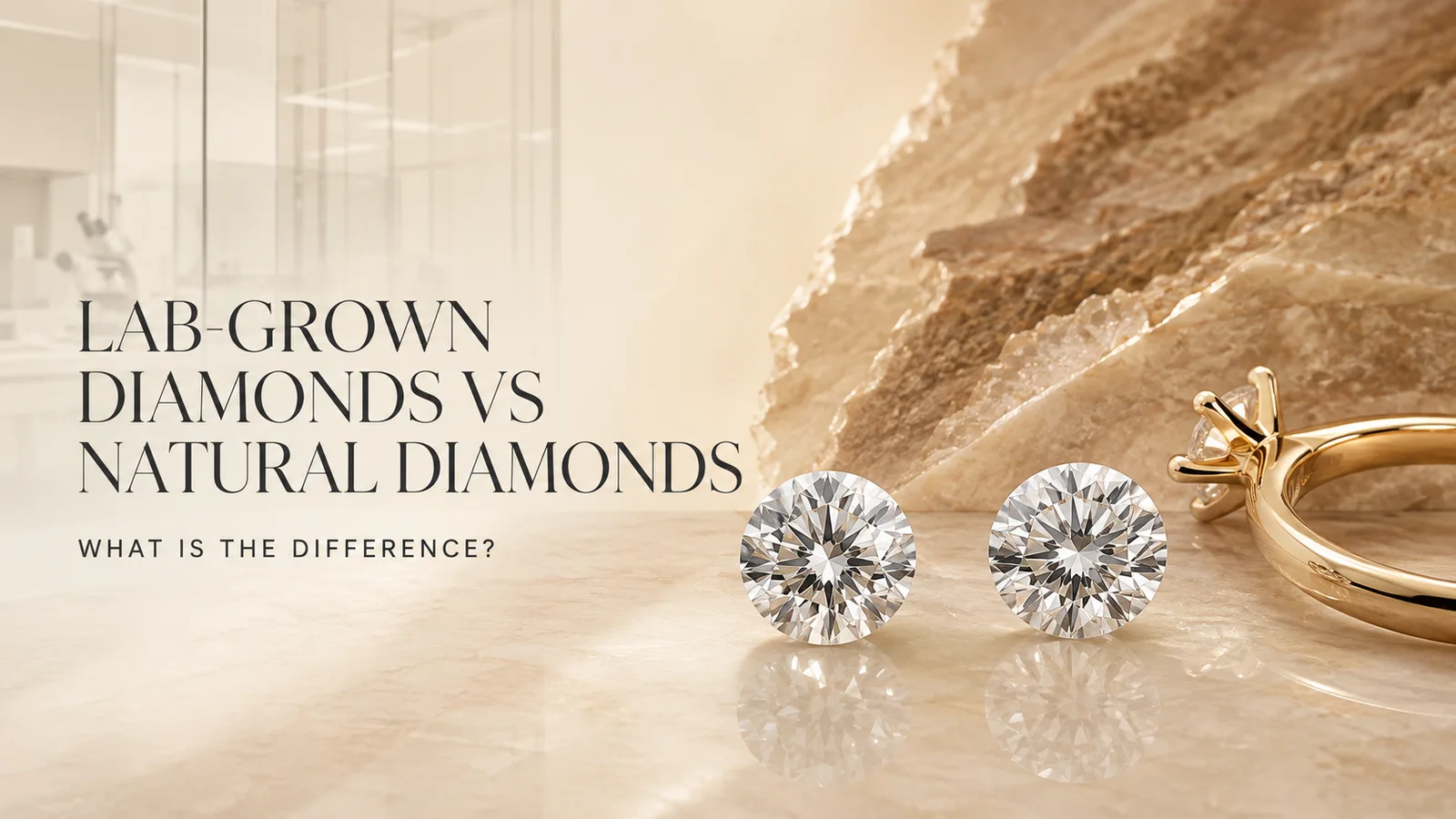
Diamonds have always represented love, celebration, elegance, and lasting beauty. Today, customers can choose between two main options: lab-grown diamonds and natural diamonds.
Both options can offer exceptional brilliance, strength, and beauty. However, they differ in origin, formation process, availability, price, and long-term value.
Understanding these differences can help you confidently select the right diamond according to your budget, preferences, and reason for purchasing.
What Is a Lab-Grown Diamond?
A lab-grown diamond is created inside a controlled laboratory using advanced technology that recreates the conditions required for diamond crystal growth.
Lab-grown diamonds are primarily produced through two recognised methods:
CVD – Chemical Vapour Deposition
In the CVD process, a thin diamond seed is placed inside a specialised chamber. Carbon-containing gases are introduced, allowing carbon atoms to gradually develop around the seed and form a diamond crystal.
HPHT – High Pressure High Temperature
The HPHT process uses intense pressure and high temperature to recreate conditions similar to those found deep within the Earth. Carbon forms around a diamond seed and gradually develops into a diamond crystal.
A lab-grown diamond has essentially the same carbon crystal structure and many of the same physical and optical properties as a natural diamond.
What Is a Natural Diamond?
A natural diamond forms deep within the Earth under intense heat and pressure. Its formation takes place naturally over an extremely long geological period.
Natural diamonds are brought closer to the Earth’s surface through geological activity. They are later recovered, sorted, cut, polished, and graded before being set into jewellery.
Their natural origin, limited availability, and geological history contribute to their rarity and market positioning.
Are Lab-Grown Diamonds Real Diamonds?
Yes, lab-grown diamonds are real diamonds.
They are not the same as cubic zirconia, glass, moissanite, or other diamond simulants. Simulants may resemble diamonds visually, but they do not have the same carbon crystal structure.
Lab-grown and natural diamonds share several important characteristics:
Both are primarily made of carbon.
Both have a crystalline diamond structure.
Both offer beautiful brilliance and sparkle.
Both are highly durable.
Both can be evaluated according to Cut, Colour, Clarity, and Carat.
Both may have inclusions and unique growth characteristics.
Specialised diamond-testing equipment and professional assessment are usually required to accurately determine whether a diamond is laboratory-grown or natural.
Lab-Grown Diamonds vs Natural Diamonds: Quick Comparison
Feature | Lab-Grown Diamond | Natural Diamond |
|---|---|---|
Origin | Created in a controlled laboratory | Formed naturally within the Earth |
Formation Time | Usually created within weeks | Formed over an extremely long geological period |
Primary Composition | Carbon | Carbon |
Appearance | Can offer exceptional brilliance | Can offer exceptional brilliance |
Hardness | Highly durable | Highly durable |
Quality Evaluation | Cut, Colour, Clarity, and Carat | Cut, Colour, Clarity, and Carat |
Price | Generally more accessible | Generally more expensive |
Availability | More flexibility in sizes and designs | Influenced by natural rarity |
Origin Identification | Requires specialised testing | Requires specialised testing |
Long-Term Value | Market prices may change | Often associated with natural rarity |
Best Suited For | Modern designs and budget flexibility | Buyers who value natural origin and rarity |
Do Lab-Grown and Natural Diamonds Look Different?
To the unaided eye, high-quality lab-grown and natural diamonds can look extremely similar.
Both can display impressive brilliance, fire, and sparkle. Their appearance is influenced more by the diamond’s cut, colour, clarity, and proportions than by its origin alone.
Even a trained jeweller may require specialised equipment or a grading report to accurately confirm the diamond’s origin.
Therefore, customers should not rely only on visual appearance. Always review the product information and diamond report before purchasing.
Do Both Types of Diamonds Have the Same Hardness?
Diamond is known for its exceptional hardness. Both lab-grown and natural diamonds have a strong crystal structure and are suitable for long-term jewellery use.
However, hardness does not mean that a diamond is impossible to damage. A diamond may still chip if struck at a vulnerable angle.
For this reason:
Choose a secure jewellery setting.
Remove delicate jewellery during heavy physical work.
Avoid strong impacts.
Arrange professional inspections for frequently worn pieces.
Understanding the 4Cs
Both lab-grown and natural diamonds are assessed using the 4Cs: Cut, Colour, Clarity, and Carat.
Cut
Cut describes how well a diamond’s facets interact with light. A well-cut diamond can offer excellent sparkle and brilliance.
Cut should not be confused with shape. Round, oval, pear, emerald, princess, and heart are diamond shapes, while cut quality refers to proportions and finishing.
Colour
The colour grade indicates how colourless or tinted a diamond appears. The preferred grade may depend on the jewellery design, gold colour, and personal taste.
Clarity
Clarity refers to the internal inclusions and external characteristics present in a diamond. Many clarity characteristics are microscopic and cannot be seen without magnification.
Carat
Carat measures the diamond’s weight, not its exact visible dimensions. Two diamonds with the same carat weight can appear slightly different in size depending on their shape and proportions.
A balanced combination of all four factors is often better than selecting a diamond based only on carat weight.
Which Diamond Offers Better Budget Flexibility?
Lab-grown diamonds are generally more accessible than natural diamonds with comparable quality characteristics.
This may allow customers to choose:
A larger centre diamond
A higher colour or clarity grade
A more detailed jewellery setting
Matching diamond jewellery
A customised design within a particular budget
Natural diamonds are generally priced higher because of their geological origin, rarity, supply chain, and market positioning.
Diamond prices can change over time. Customers should compare current prices and focus on the design, quality, certification, and purpose of their purchase.
What About Resale Value?
Resale value should be considered separately from beauty, quality, and emotional value.
Natural diamonds have traditionally had a more established resale market because of their rarity and long-standing market presence. However, resale prices may still be significantly different from the original retail price.
Lab-grown diamond prices and resale markets continue to evolve as production technology and availability change.
Neither option should be presented as a guaranteed financial investment. Before purchasing, ask the jeweller about applicable exchange, upgrade, buyback, and resale policies.
Which Is Better for Engagement Rings?
Both lab-grown and natural diamonds can be excellent choices for engagement rings.
Consider a Lab-Grown Diamond If You:
Want a larger-looking centre stone within your budget
Prefer a modern diamond option
Want greater flexibility in design and quality
Are comfortable with its laboratory origin
Value appearance and personal meaning over rarity
Consider a Natural Diamond If You:
Prefer a diamond formed naturally within the Earth
Value rarity and geological history
Want a traditionally established diamond option
Are comfortable with a higher budget
Place importance on natural origin
The best engagement ring is one that suits the wearer’s style, lifestyle, preferences, and budget.
Which Is Better for Everyday Jewellery?
Lab-grown diamonds can be particularly suitable for everyday jewellery because they combine diamond beauty with greater budget flexibility.
They can be used in:
Minimal diamond pendants
Everyday earrings
Diamond nose pins
Delicate rings
Diamond mangalsutras
Tennis bracelets
Office-wear jewellery
Personalised gifts
Natural diamonds are also suitable for everyday wear, provided the jewellery has a secure setting and is maintained properly.
Diamond Certification and Disclosure
Whether you choose a lab-grown or natural diamond, clear product information is essential.
Before buying, check:
Whether the diamond is laboratory-grown or natural
The diamond’s Cut, Colour, Clarity, and Carat
The grading or certification report
Whether any treatments have been disclosed
The gold purity used in the jewellery
The BIS Hallmark and applicable HUID details
The product’s measurements and total diamond weight
The invoice, warranty, and return policy
Diamond certification and gold hallmarking serve different purposes.
A diamond grading report provides information about the diamond.
A BIS Hallmark confirms the declared purity of the gold used in the jewellery.
Is a Lab-Grown Diamond More Sustainable?
Lab-grown diamonds do not require traditional diamond mining, but their overall environmental impact can vary depending on the production method, energy source, manufacturing facility, and supply chain.
For this reason, avoid assuming that every lab-grown diamond has the same environmental footprint. If sustainability is important to you, ask the jeweller or supplier for transparent information about production and energy sourcing.
How Do You Choose Between Them?
Ask yourself these questions before making your decision:
What is my overall jewellery budget?
Is natural rarity important to me?
Do I prefer a larger diamond within my budget?
Is the diamond certified?
Which Cut, Colour, and Clarity combination suits me?
Will the jewellery be worn every day or occasionally?
What are the jeweller’s return, exchange, and warranty policies?
Which option feels more meaningful to me?
There is no single option that is right for everyone. The best diamond is the one that provides the right balance of quality, beauty, meaning, and budget for you.
Frequently Asked Questions
Can you tell the difference between lab-grown and natural diamonds by looking at them?
Usually, no. High-quality lab-grown and natural diamonds can look extremely similar. Specialised testing equipment and a grading report are required for reliable identification.
Are lab-grown diamonds fake?
No. Lab-grown diamonds are real diamonds created in a controlled laboratory. They should not be confused with diamond simulants such as cubic zirconia.
Do lab-grown diamonds become cloudy over time?
A properly created and maintained lab-grown diamond does not become cloudy simply because it was grown in a laboratory. Dirt, oil, lotion, and residue can reduce its visible sparkle, so regular cleaning is recommended.
Do natural diamonds sparkle more?
Not necessarily. Sparkle depends significantly on cut quality, proportions, polishing, and cleanliness. A well-cut lab-grown diamond may sparkle more than a poorly cut natural diamond.
Which diamond is more affordable?
Lab-grown diamonds are generally more accessible than natural diamonds with comparable quality characteristics.
Can lab-grown diamonds be used in gold jewellery?
Yes. Lab-grown diamonds can be set in Yellow Gold, White Gold, or Rose Gold, depending on the design and customer preference.
Does a BIS Hallmark certify the diamond?
No. A BIS Hallmark confirms the purity of the gold used in the jewellery. Diamond grading and gold hallmarking are separate forms of verification.
Which diamond is best for gifting?
Both can make meaningful gifts. Lab-grown diamonds offer greater budget and design flexibility, while natural diamonds appeal to customers who value natural origin and rarity.
Find the Diamond That Is Right for You
At Ellips Diamond Jewellers, we offer elegant jewellery crafted for everyday moments and unforgettable celebrations.
Explore our collection of rings, pendants, earrings, nose pins, mangalsutras, and bracelets, or contact us for a customised design.
Certified Lab-Grown Diamonds • BIS-Hallmarked Gold • Customisation Available
Contact: support.ellips@gmail.com
Ellips Diamond Jewellers